
ChatGPT may not mention your brand because it does not simply rank websites the way traditional Google search does. AI systems need to understand who your brand is, what you do, whether your information is trustworthy, and whether your brand is relevant to the question being asked.
If your brand has weak online authority, inconsistent information, limited third-party mentions, unclear positioning, or little useful content around your category, an AI system may have fewer reasons to mention you.
That is where GEO SEO becomes important.
The Bigger Question Isn’t “Why Am I Not Ranking?”
For years, marketers asked:
“Why isn’t my website ranking on Google?”
Now there is another question:
“Why doesn’t ChatGPT mention my brand?”
These sound similar.
They’re not.
Google traditionally gives you a list of links.
AI search systems increasingly provide an answer.
That changes the marketing game.
A user might ask:
“What are the best performance marketing agencies for an e-commerce business?”
Instead of scrolling through ten blue links, they may receive a short list of recommendations.
If your competitor appears and you don’t, you have an AI visibility problem.
Problems → Questions → Intent → Solutions
This is the framework I use to think about modern search.
Problem
Your brand isn’t appearing in AI-generated recommendations.
Question
Why doesn’t ChatGPT know or mention my company?
Intent
The business owner wants to increase visibility and become more discoverable in AI search.
Solution
Build stronger brand entities, topical authority, structured information, third-party validation and useful content.
This is the foundation of GEO.
How Does ChatGPT Know About a Brand?
This is where marketers often misunderstand AI search.
ChatGPT isn’t simply looking at your homepage and deciding:
“This company looks good. I’ll recommend it.”
AI systems can use different forms of information depending on the product, search experience, available tools and retrieval systems.
The important concept for marketers is discoverability and corroboration.
Your brand needs to be understandable beyond your own website.
Think about your online presence as a network:
Your Website
↓
↓
Directories
↓
Social Platforms
↓
Industry Websites
↓
Reviews
↓
News / Publications
↓
Other Websites
↓
AI Search
The more consistent and credible your brand information is across the ecosystem, the easier it becomes for search systems to understand the entity.
1. Your Brand Isn’t Clearly Defined
One of the biggest problems is surprisingly simple.
Google and AI systems need to understand:
Who are you?
What do you do?
Who do you serve?
Where do you operate?
What are you known for?
Imagine your website says:
“We help businesses grow.”
That’s vague.
Now compare:
“Farooq Shafi is a performance marketing specialist focused on Google Ads, Meta Ads, conversion rate optimization and customer acquisition for e-commerce, SaaS and B2B businesses.”
The second statement creates much stronger semantic relationships.
Farooq Shafi → Performance Marketing → Google Ads → Meta Ads → CRO → Customer Acquisition
That is an entity.
2. Your Website Doesn’t Have Enough Topical Authority
One article isn’t enough to establish expertise around a subject.
Imagine your website has one article:
“What is Google Ads?”
Then another website has:
- Google Ads strategy
- Google Ads benchmarks
- Google Ads conversion tracking
- Google Ads bidding
- Google Ads mistakes
- Google Ads landing pages
- Google Ads for e-commerce
- Google Ads for SaaS
- Google Ads vs Meta Ads
- Google Ads case studies
Which website gives an AI system more context?
The second one.
This is topical authority.
3. You’re Only Talking About Yourself
This is a major content mistake.
Your website says:
“We are the best.”
“We provide amazing services.”
“We are experts.”
But there is little educational content explaining the subject.
AI systems need useful information.
Instead of writing only promotional pages, create resources such as:
How to Reduce Customer Acquisition Cost
Why Meta Ads Stop Converting
Google Ads vs Meta Ads
How to Calculate ROAS
How to Improve Landing Page Conversion Rate
Now your website isn’t just a brochure.
It’s a knowledge source.
4. Your Brand Has Weak Third-Party Signals
Here’s a fundamental SEO principle:
Your website controls what it says about itself.
Third-party websites provide independent context.
For example:
Your website says:
“Farooq Shafi is a performance marketer.”
That’s one signal.
Then other websites, profiles, interviews, podcasts, publications, professional directories and social profiles consistently associate you with:
Performance Marketing
Google Ads
Meta Ads
CRO
Now the relationship becomes much stronger.
This is why digital PR, genuine mentions, expert contributions and authoritative citations can support entity visibility.
Do not confuse this with buying fake links or fabricated mentions.
The goal is real-world corroboration.
5. Your Brand Information Is Inconsistent
Imagine these five pages:
Website:
Farooq Shafi Digitals
LinkedIn:
Farooq Shafi Digital
Google Business Profile:
Farooq Shafi Marketing
Instagram:
FSD Agency
Directory:
Farooq Shafi Digital Agency
Now the search ecosystem has to determine whether these are:
one entity or five entities.
Make your important information consistent:
- Brand name
- Founder
- Website
- Services
- Location
- Social profiles
- Company description
- Business category
Consistency helps machines understand relationships.
6. You Don’t Have Enough Answer-Based Content
Traditional SEO often focuses heavily on keywords.
GEO requires thinking about questions.
For example, don’t only publish:
“Customer Acquisition Cost”
Build content around questions:
What is a good CAC for e-commerce?
How do I calculate CAC?
Why is my CAC increasing?
How can I reduce CAC?
What is the difference between CAC and CPA?
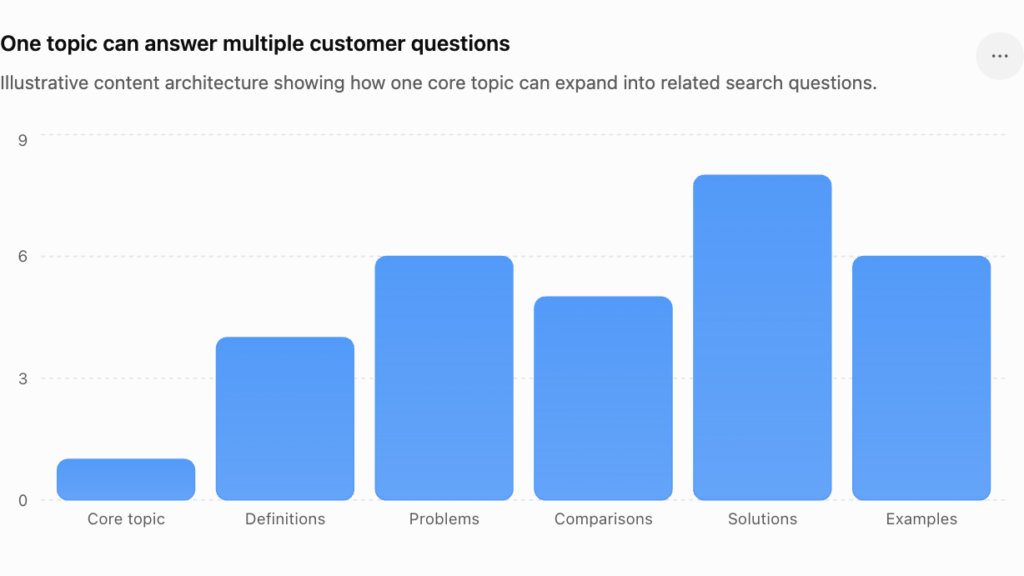
Now one topic becomes a knowledge graph.
One topic can answer multiple customer questions
7. Your Content Doesn’t Demonstrate Experience
AI search isn’t just about repeating information everyone already knows.
Original experience is valuable.
Instead of:
“CRO is important.”
Explain:
“A common CRO mistake is optimizing button color before understanding why users aren’t converting.”
Then explain:
- What you observed
- What you tested
- What changed
- What you learned
- What businesses should do differently
This gives your content something generic AI-generated articles don’t have:
experience.
8. Your Brand Isn’t Associated With the Right Topics
Let’s say someone asks:
“Who are the best neuromarketing experts?”
But your website mainly talks about:
- Web design
- Graphic design
- Social media
- Logo design
Even if you understand neuromarketing, your digital footprint may not strongly associate you with it.
Your content needs to consistently reinforce the topics you want to own.
For FarooqShafi.com, that could mean building strong relationships around:
Farooq Shafi
→ Performance Marketing
→ Google Ads
→ Meta Ads
→ CRO
→ Marketing Psychology
→ Neuromarketing
→ Marketing Funnels
→ Customer Acquisition
→ SEO
→ GEO
That is how personal-brand topical authority compounds.
9. You Don’t Have Original Data
This is one of the biggest opportunities for GEO.
Imagine two articles.
Article A
“10 ways to improve your Meta Ads.”
Article B
“We analyzed 500 campaigns and found 7 recurring reasons Meta Ads stopped converting.”
Which one is more interesting?
The second.
Original:
- Research
- Benchmarks
- Surveys
- Experiments
- Case studies
- Statistics
- Industry data
can make your content more useful and more reference-worthy.
You don’t need millions of visitors.
You need something worth citing.
10. Your Content Isn’t Structured for Questions
AI systems need to understand relationships between concepts.
Don’t create enormous blocks of text.
Use:
Definitions
Questions
Examples
Tables
Comparisons
Frameworks
Checklists
FAQs
Conclusions
For example:
| Question | Intent | Best Content |
|---|---|---|
| What is GEO? | Informational | Definition guide |
| Why isn’t my brand appearing? | Problem-solving | Diagnostic article |
| How do I improve AI visibility? | Solution | GEO strategy |
| What GEO tools should I use? | Commercial | Comparison |
| Who can help with GEO? | Transactional | Service page |
This structure is useful for both humans and search systems.
11. Your Website Doesn’t Connect Its Content
Suppose you publish 50 excellent articles.
But none of them link to each other.
You’ve created 50 isolated islands.
Instead, build topic clusters.
For example:
GEO SEO
↓
What Is GEO?
↓
Why ChatGPT Doesn’t Mention Your Brand
↓
How to Get Your Brand Mentioned in ChatGPT
↓
How AI Search Chooses Brands
↓
GEO vs SEO
↓
How to Measure AI Search Visibility
↓
GEO Tools
↓
GEO Strategy for Businesses
Now Google and users can understand the relationship between your pages.
12. Your Brand Has No “About” Entity Information
Your About page isn’t just a formality.
For a personal brand, it should clearly explain:
Who is Farooq Shafi?
What does he specialize in?
What industries does he work with?
What experience does he have?
What companies or projects has he worked with?
Where can people verify his professional identity?
Think of your About page as the identity layer of your website.
13. Your Author Signals Are Weak
For expert-led websites, author information matters.
Create a strong author profile containing:
- Name
- Professional background
- Areas of expertise
- Experience
- Credentials
- Publications
- Social profiles
- Relevant work
- Contact information
Then connect your articles to that author.
You are effectively telling search systems:
This content was created by a person with identifiable expertise in this subject.
14. You Are Optimizing Only for Google
This is probably the biggest mindset shift.
Don’t build your website only for:
Google rankings.
Build it for:
People + Google + AI systems.
The same content can potentially serve:
Google Search
AI Overviews
ChatGPT
Gemini
Perplexity
Claude
Voice Search
But the content needs to be genuinely useful first.
The GEO Visibility Model
Here’s the simple model I would use:
Entity Clarity
Topical Authority
Original Experience
Third-Party Validation
Structured Content
Search Intent Alignment
=
Stronger AI Visibility
It isn’t a guaranteed formula for getting mentioned.
There is no legitimate trick that guarantees ChatGPT will recommend a particular brand.
But these are the foundations that make a brand easier to understand, discover and evaluate.
How to Make ChatGPT More Likely to Understand Your Brand
Start with your entity.
Step 1: Define Your Brand
Write one clear sentence.
Who are you + what do you do + who do you help?
Step 2: Build Your Topic Map
Choose 5–10 topics you want your brand associated with.
Step 3: Create Question-Based Content
For every topic, identify:
Problems → Questions → Intent → Solutions
Step 4: Build Supporting Content
Don’t stop after one article.
Create a cluster.
Step 5: Add Original Insights
Use:
- Data
- Experiments
- Case studies
- Examples
- Personal experience
Step 6: Strengthen Your Entity
Make your brand information consistent across legitimate platforms.
Step 7: Build Genuine Authority
Earn:
- Interviews
- Mentions
- Expert contributions
- Publications
- Podcasts
- Industry references
Step 8: Connect Everything
Use internal links to create a coherent knowledge structure.
How to Check If ChatGPT Knows Your Brand
Don’t test it once.
Create a repeatable test.
Ask several neutral questions.
For example:
“Who are some performance marketing experts in Pakistan?”
Then:
“Who are some Pakistani experts in conversion rate optimization?”
Then:
“What are some good resources for learning Google Ads in Pakistan?”
Then:
“Which Pakistani marketers talk about neuromarketing?”
Record:
- Was your brand mentioned?
- Which competitors appeared?
- What sources were referenced?
- What topics triggered mentions?
- How frequently did your brand appear?
Repeat the test over time.
This becomes your AI visibility benchmark.
The Important Warning About AI Visibility
Don’t try to manipulate AI systems with fake reviews, fake articles, fake citations or mass-produced content.
The goal isn’t:
“How can I trick ChatGPT into mentioning me?”
The better question is:
“How can I become genuinely relevant enough that an AI system has a reason to mention me?”
That distinction matters.
The Future of Brand SEO
Traditional SEO was largely about:
Rankings.
Modern search is increasingly about:
Visibility.
And visibility can happen in different places.
A customer might discover your brand through:
Google → AI Overview → ChatGPT → YouTube → Maps → LinkedIn → Website
Your brand doesn’t necessarily need to win one search result.
It needs to become recognizable across the customer’s information journey.
Final Thoughts
If ChatGPT doesn’t mention your brand, don’t immediately assume:
“I need more keywords.”
You may actually need:
More clarity.
More authority.
More useful content.
More original insights.
More consistent entity information.
More genuine third-party validation.
And most importantly:
A stronger association between your name and the topics you want to own.
The future of SEO isn’t simply about getting your page to position #1.
It’s about making your brand understandable, relevant and credible wherever people search for answers.
And that is the real opportunity behind GEO SEO.
Key Takeaways
- ChatGPT visibility isn’t the same thing as traditional Google rankings.
- Your brand needs a clear and consistent digital identity.
- Topical authority helps establish strong relationships between your brand and important subjects.
- Question-based content is more useful than keyword-only content.
- Original research and first-hand experience can differentiate your content.
- Genuine third-party mentions can strengthen brand authority.
- Internal linking helps connect your website’s knowledge structure.
- GEO should complement SEO, not replace it.
- No legitimate tactic guarantees that ChatGPT will recommend a particular brand.
- Your goal should be becoming genuinely relevant, not manipulating AI recommendations.