 Farooq Shafi
Imagine building one of the most influential technology companies in the world, leading it for more than three decades, and becoming one of the most recognisable faces of the artificial intelligence revolution.
Then, suddenly, you are no longer its CEO.
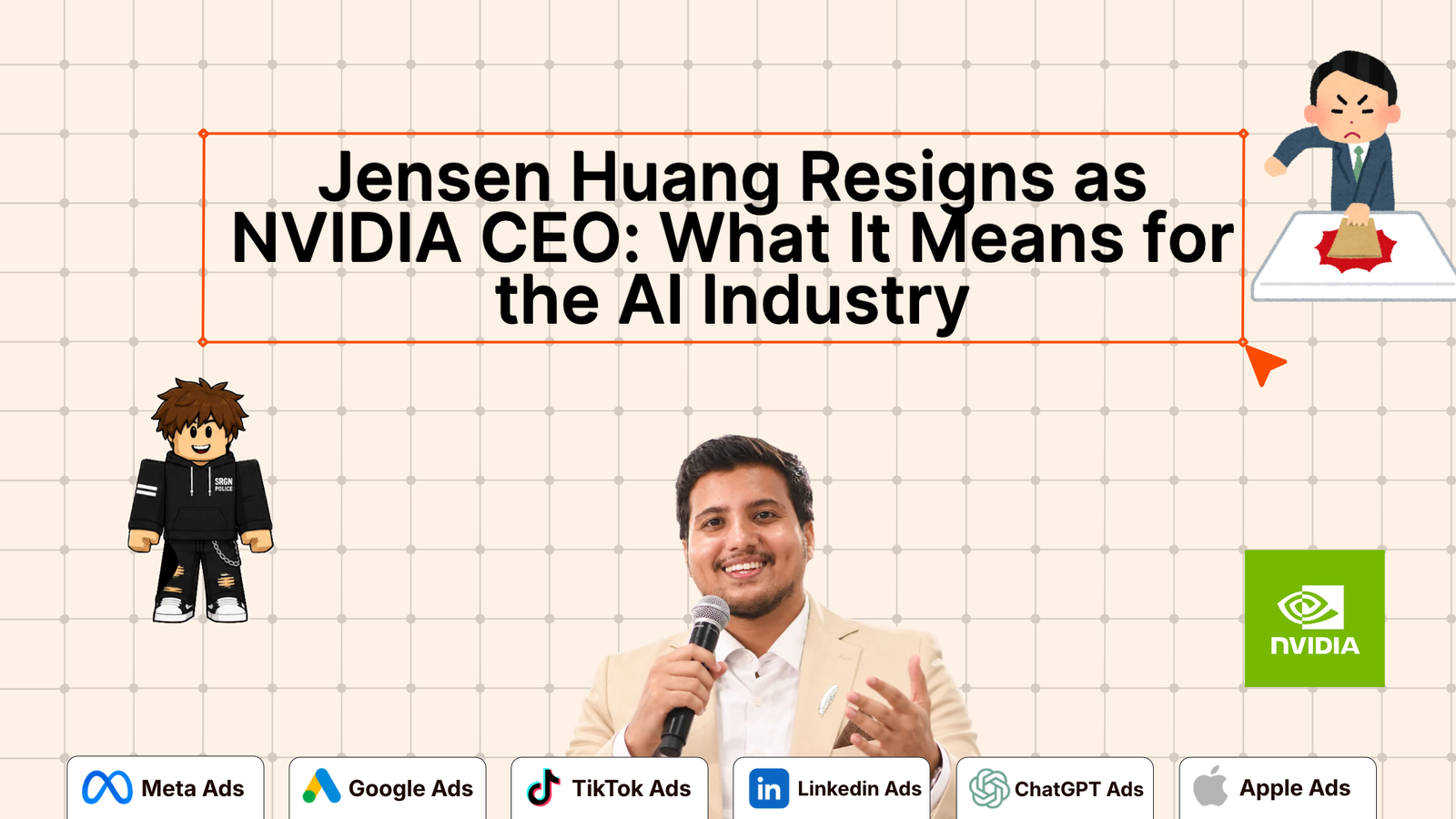
On November 12, 2026, NVIDIA announced that its co-founder and CEO, Jensen Huang, had resigned from his position with immediate effect. The company appointed its long-time CFO, Colette Kress, as interim CEO while its board begins searching for a permanent successor.
This is more than a leadership change at a technology company.
NVIDIA sits at the centre of the global AI infrastructure market. Its GPUs power data centres, AI models, cloud platforms and countless products being developed by technology companies.
So the important question is not simply why Jensen Huang left.
The bigger question is: what happens to the AI industry when one of its most influential leaders steps away?
Let’s break it down.
1. What Happened at NVIDIA?
NVIDIA officially announced that Jensen Huang had resigned as president, CEO and a member of its board of directors.
The company appointed Colette Kress, its executive vice president and chief financial officer, as interim CEO. She will continue handling her CFO responsibilities while the board searches for a permanent replacement.
The board also appointed Harvey C. Jones as NVIDIA’s first-ever chair.
Huang led NVIDIA for approximately 33 years, transforming it from a graphics-chip company into one of the most important businesses in the artificial intelligence ecosystem.
The company thanked Huang for his contributions and said it would continue advancing its work in accelerated computing and AI.
You can read the announcement directly from NVIDIA’s official newsroom.
2. Why Is Jensen Huang’s Departure Such a Big Deal?
Because NVIDIA is not just another technology company.
It is a critical supplier of the computing infrastructure behind modern AI.
Think about what happens when someone uses an AI product:
- A business generates content using an AI assistant.
- A developer builds an application using an AI model.
- A company trains a large language model.
- A cloud provider runs AI workloads for thousands of customers.
All of these activities require computing infrastructure.
NVIDIA has become a major provider of that infrastructure through its GPUs, networking technology and software ecosystem.
This creates an important connection between NVIDIA and the wider technology industry.
A major leadership transition at NVIDIA can influence investor confidence, industry expectations, strategic partnerships and conversations about the future of AI infrastructure.
However, a change in leadership does not automatically mean a change in the company’s technology direction.
3. Who Is Colette Kress, NVIDIA’s Interim CEO?
Colette Kress is not an outsider brought in to manage a crisis.
She has served as NVIDIA’s executive vice president and chief financial officer since September 2013.
Before joining NVIDIA, she spent nearly 25 years working in finance roles at major technology companies, including Cisco and Microsoft.
Her experience gives her a detailed understanding of NVIDIA’s financial operations, customers and business structure.
But taking over from a founder who has led a company for 33 years is a different challenge.
Her immediate responsibilities include maintaining business continuity, supporting investor confidence, overseeing the leadership transition and helping the company continue executing its AI strategy.
The board has said it will consider both internal and external candidates for the permanent CEO position.
4. What Happens to NVIDIA’s AI Business Now?
This is where things become particularly interesting.
NVIDIA’s competitive position is not built entirely around one individual.
Its business includes several important strengths:
Hardware: GPUs and accelerated computing systems used for demanding AI workloads.
Software: CUDA and its wider developer ecosystem, which help developers build and run applications on NVIDIA hardware.
Data centres: Infrastructure products designed for organisations deploying AI at scale.
Partnerships: Relationships with cloud providers, technology companies, developers and enterprise customers.
These are business assets that cannot simply disappear because a CEO changes.
The key challenge is maintaining execution, customer confidence and innovation during the transition.
The company has indicated that its operations, customer commitments and product roadmap are expected to continue without interruption.
That is an important message for customers and partners.
5. Could NVIDIA’s Competitors Benefit?
Possibly.
A leadership transition at a dominant technology company creates an opportunity for competitors to attract attention.
Companies such as AMD and other semiconductor manufacturers are competing for a share of the growing AI computing market.
Cloud providers are also developing their own chips and infrastructure to reduce dependence on external suppliers.
If customers begin reassessing their technology partnerships, competitors could benefit from new opportunities.
But switching an entire AI infrastructure ecosystem is not easy.
Businesses have to consider performance, software compatibility, developer experience, reliability, availability and total operating costs.
A competitor may offer an attractive chip, but the complete technology ecosystem matters just as much.
6. What Should Investors Watch?
For investors, the next few months will be important.
Here are five areas worth monitoring:
- Leadership succession: Who eventually becomes NVIDIA’s permanent CEO?
- Financial performance: Does the company maintain its growth and profitability?
- AI infrastructure demand: Do businesses continue investing in AI computing?
- Competition: Can AMD and other suppliers gain meaningful market share?
- Customer confidence: Do major cloud providers and enterprise customers maintain their NVIDIA commitments?
NVIDIA’s next scheduled quarterly financial results are also important because they will provide investors with updated information about the company’s business performance.
One leadership announcement should not be treated as a complete investment thesis. Investors need to evaluate the company’s financial results, competitive position, valuation and future prospects.
7. What Does This Mean for Small Businesses and Entrepreneurs?
Here is the part that matters beyond Wall Street.
You do not need to own NVIDIA shares to be affected by developments in the AI industry.
If you run a marketing agency, e-commerce company, SaaS business or technology startup, AI infrastructure influences the tools and platforms you use.
Consider these opportunities:
Marketing agencies: AI can help with research, campaign planning, creative production and reporting.
E-commerce businesses: AI can support customer service, product discovery, personalisation and operational automation.
Software companies: AI infrastructure makes it possible to build new products and integrate intelligent features into existing applications.
Freelancers: AI tools can help individuals deliver services more efficiently and compete in international markets.
The bigger opportunity is not simply watching which company becomes the next technology giant.
It is learning how to use the technology to build something valuable.
I have written more about practical marketing and business growth in my digital marketing blog.
You can also explore my free digital marketing tools to improve your marketing workflow.
8. Is This the End of NVIDIA’s AI Dominance?
Not necessarily.
NVIDIA’s position has been built through years of investment in hardware, software, research, partnerships and developer adoption.
A CEO transition introduces uncertainty, but it does not automatically erase those advantages.
The real test will be whether the company can continue innovating, retain customer confidence and execute its long-term strategy under new leadership.
The AI industry is also becoming more competitive. More companies are developing chips, models, applications and infrastructure.
That means NVIDIA cannot depend on its historical success alone.
It must keep earning its position.
Final Thoughts: The AI Industry Is Bigger Than One Person
Jensen Huang’s departure marks an important moment in the history of NVIDIA.
For more than three decades, he helped build the company into a major force in computing and artificial intelligence.
Now, Colette Kress faces the challenge of leading the company through a significant transition.
But there is a bigger lesson for entrepreneurs and business owners.
Build companies that are stronger than the people leading them.
Leadership matters. Vision matters. Founders matter.
But sustainable businesses need strong teams, systems, technology, governance and the ability to adapt.
The AI revolution is not ending because one CEO has resigned. If anything, this transition gives the industry another reason to think about leadership, competition and what comes next.
And for entrepreneurs, the opportunity remains the same: learn the technology, identify real problems and build solutions people are willing to pay for.
Frequently Asked Questions
1. Has Jensen Huang resigned as NVIDIA CEO?
Yes. NVIDIA announced on November 12, 2026, that Jensen Huang had resigned as president and CEO, effective immediately.
2. Who is the new NVIDIA CEO?
Colette Kress, NVIDIA’s executive vice president and CFO, has been appointed interim CEO while the board searches for a permanent successor.
3. How long did Jensen Huang lead NVIDIA?
Huang led NVIDIA for approximately 33 years.
4. Will NVIDIA continue developing AI chips?
NVIDIA has indicated that its operations, customer commitments and product roadmap are expected to continue without interruption during the leadership transition.
5. Will NVIDIA lose its position in the AI industry?
There is no basis to conclude that from the resignation alone. Its future position will depend on innovation, competition, customer demand and execution under its new leadership.
6. Should investors sell NVIDIA shares?
A CEO transition alone is not enough to determine whether an investor should buy or sell. Investors should assess the company’s financial performance, valuation, competitive position and risk tolerance.